How to Choose the Best Medspa Marketing Agency in 2026 | DC Consulting Group
Discover the 8 criteria every medspa owner must use when choosing a marketing agency in 2026. From AI search readiness to tech stack integration — DC Consulting Group breaks it all down.
Finding the right medspa marketing agency in 2026 is harder than it looks. Most agencies claiming to “specialize” in medspas are general digital shops with one or two aesthetics clients on their roster. The ones that genuinely understand your industry — treatment cycles, patient psychology, compliance requirements, and the cash-pay model — are rare.
But there’s an even bigger problem that almost no marketing agency will bring up in a sales call: your marketing can only be as effective as the technology behind it. If your EMR, CRM, booking platform, and website aren’t properly integrated, even the best ad campaigns in the world will underperform. Leads fall through the cracks. Search rankings stagnate. Revenue attribution becomes impossible.
This guide gives you the 8 criteria you need to evaluate any marketing agency — and explains why DC Consulting Group approaches medspa growth differently than any traditional marketing firm.
Why Choosing the Wrong Agency Is Expensive
A mismatched agency relationship doesn’t just fail to grow your business — it actively drains it. You pay monthly retainers while competitors pull ahead in search rankings. You invest in ad campaigns without reliable attribution. And by the time you realize the partnership isn’t working, months (or years) have passed.
The medspa industry has unique challenges that generic marketing firms simply aren’t built for:
- Aesthetic marketing carries compliance requirements around before/after imagery, treatment claims, and before/after testimonials that generic agencies routinely get wrong
- Medspa clients operate on a cash-pay model where lifetime value and rebooking rates matter more than one-off conversions
- Treatment demand is seasonal — injectables peak in fall/winter, body treatments in spring/summer — and your marketing calendar must reflect that
- AI search platforms like ChatGPT and Perplexity are now influencing up to 90% of healthcare research queries, and most agencies have no strategy for this
The right agency prevents these compounding costs. The wrong one guarantees them. Here’s how to tell the difference.
8 Criteria to Evaluate Any Medspa Marketing Agency
There’s a meaningful difference between an agency that “works with healthcare brands” and one that has built real campaigns for medspa and aesthetic practices. The former treats your business like a dentist’s office or urgent care clinic. The latter understands that medspa clients are making emotional, high-consideration purchases — not urgent medical decisions.
Real medspa expertise means understanding treatment-specific content restrictions, knowing which services drive the highest lifetime value, and recognizing that a client who comes in for Botox is also a prospect for body contouring, laser resurfacing, and memberships.
In 2026, AI platforms like ChatGPT, Perplexity, and Google AI Overviews are rapidly replacing traditional search as the first point of discovery for high-intent consumers. When a patient asks “What’s the best medspa in [city] for Botox?” they’re increasingly getting an AI-generated answer — not a list of links.
If your agency’s SEO strategy doesn’t include Generative Engine Optimization (GEO) — building your brand’s authority so AI platforms cite you as a trusted source — you’re being optimized for a search paradigm that’s already changing. Most agencies are still focused purely on Google rankings. The best ones are building authority that works across both traditional and AI-mediated search.
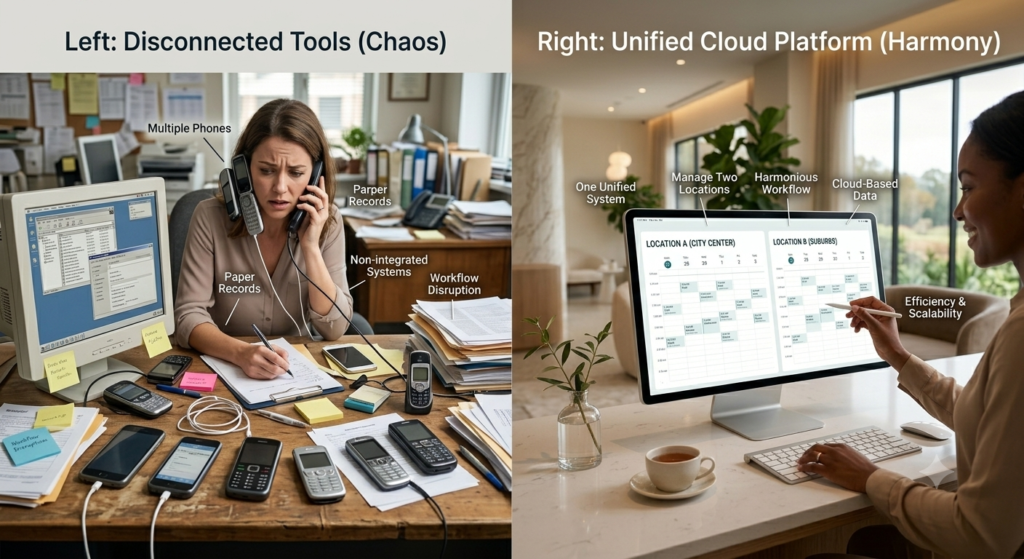
This is the criterion most medspa owners don’t know to ask about — and it’s arguably the most important one. Your marketing results are directly constrained by your technology infrastructure. If your booking system redirects patients to a third-party domain, you’re sending your SEO authority to that vendor’s website — not yours. If your EMR, CRM, and POS don’t communicate, your reporting is unreliable. If your website doesn’t have clean URL architecture and structured data for each location, AI crawlers can’t build a complete picture of your authority.
A marketing agency that doesn’t ask about your tech stack before proposing a strategy is either naive or indifferent to your results. The best partnerships — or the most responsible approach — involves ensuring your infrastructure can support the campaigns being proposed.
A significant number of medspa marketing consultants and agencies have financial relationships with the platforms they recommend. Referral fees, white-label arrangements, and platform partnerships create conflicts of interest that directly affect the advice you receive. An agency earning a commission from an EMR vendor isn’t recommending that vendor because it’s right for you — they’re recommending it because it’s right for their revenue.
True vendor neutrality means every recommendation is made purely on the basis of what improves your performance, reduces your costs, and supports your specific growth goals. Before signing any contract, ask explicitly about financial relationships with software vendors.
Medspa marketing sits in a regulated environment. Google Ads has specific restrictions on before/after imagery in healthcare advertising. Meta has rules governing what claims can be made about medical aesthetic treatments. State medical boards have oversight over how certain procedures can be marketed. HIPAA considerations apply to any client data used in retargeting campaigns.
A marketing agency that isn’t fluent in these constraints will cost you more than their retainer — in disapproved ads, takedown notices, and reputational risk. Compliance awareness isn’t optional in this space; it’s a baseline competency.
The metric that matters for a medspa is booked appointments — not impressions, reach, or follower counts. Any agency that leads with vanity metrics is telling you something important about what they’re optimizing for. The best agencies tie their work directly to business outcomes: cost per qualified lead, booking conversion rate, revenue attributed to specific campaigns, and rebooking rates from existing clients.
Ask for specific numbers from comparable clients. Not testimonials — actual data. “We increased bookings by 34%” is a useful claim. “Our clients love working with us” is not.
You should know at any point in time what your marketing dollars are producing. Monthly reporting is the minimum — but the quality of that reporting matters more than the frequency. A well-structured dashboard showing bookings attributed by channel, cost per lead by campaign, and organic traffic by treatment page tells you something actionable. A PDF with screenshots of follower growth does not.
Ask to see an example report before you sign. Make sure it contains data tied to revenue outcomes, not just marketing activity.
Long-term lock-in contracts are common in medspa marketing — and they almost always favor the agency, not the client. A 12-month agreement signed before an agency has demonstrated results puts all the risk on you. Month-to-month or performance-reviewed contracts reflect an agency confident in their ability to deliver.
Equally important: who owns your assets? Your website, ad creative, content library, and data should belong to you — not the agency. If you leave a partnership and the agency retains ownership of your website or ad account history, you’re starting over. Clarify asset ownership before signing anything.
5 Red Flags to Walk Away From
Beyond the criteria above, watch for these warning signs during the agency evaluation process:
- They pitch strategy before asking about your tech stack. No responsible marketing partner proposes campaigns without understanding your infrastructure. Skipping this step means they’re selling you a plan that may not be executable given your current systems.
- They can’t name the compliance restrictions on medspa advertising. If they don’t know that Google prohibits before/after imagery in healthcare ads, or that Meta has restrictions on medical claim language, they’re going to run campaigns that get disapproved — and waste your budget.
- They guarantee specific ranking positions or follower counts. No ethical agency guarantees #1 Google rankings. SEO outcomes depend on dozens of factors, many of which are outside any agency’s control. Guarantees like this signal either dishonesty or inexperience.
- Their reporting focuses on reach and impressions. If the agency’s success metrics are views, likes, and follower growth rather than booked appointments and revenue, their incentives are misaligned with yours.
- 12-month lock-in before showing any results. Demanding a year-long commitment before delivering a single outcome is a risk structure that only benefits the agency. Walk away or negotiate a performance review clause after 90 days.
The insight most agencies won’t share: Marketing campaigns can only deliver as much as your underlying systems allow. If your booking flow redirects patients off your domain, if your data doesn’t flow cleanly between platforms, and if your website isn’t structured for AI search — no amount of ad spend will compensate for the compounding authority you’re losing every month.
We Don’t Just Run Campaigns. We Fix the Foundation They Run On.
Most medspa marketing agencies start with ads and content. DC Consulting Group starts with your technology infrastructure — because that’s where marketing results are actually won or lost.
Frequently Asked Questions
Ready to Build a Medspa Tech Stack That Actually Works?
Start with a free audit. We’ll identify exactly where your systems are costing you rankings, revenue, and growth — with no obligation.
Related Articles
 Medspa Growth
How to Scale Your Medspa to Multiple Locations Without Breaking Your Tech Stack
Medspa Growth How to Scale Your Medspa to Multiple Locations Without Breaking Your Tech Stack A practical guide to expanding…
Uncategorized
Medspa Tech Stack Guide | What Every Practice Needs | DC Consulting
Discover the medspa tech stack that determines your visibility, bookings, and revenue. Learn 7 critical systems, how they integrate, and…
Uncategorized
How AI Search Is Changing Medspa Patient Discovery in 2026 | DC Consulting
AI search medspa visibility is reshaping patient discovery. Learn how ChatGPT, Perplexity, and Google AI Overviews are replacing traditional search…
Medspa Growth
How to Scale Your Medspa to Multiple Locations Without Breaking Your Tech Stack
Medspa Growth How to Scale Your Medspa to Multiple Locations Without Breaking Your Tech Stack A practical guide to expanding…
Uncategorized
Medspa Tech Stack Guide | What Every Practice Needs | DC Consulting
Discover the medspa tech stack that determines your visibility, bookings, and revenue. Learn 7 critical systems, how they integrate, and…
Uncategorized
How AI Search Is Changing Medspa Patient Discovery in 2026 | DC Consulting
AI search medspa visibility is reshaping patient discovery. Learn how ChatGPT, Perplexity, and Google AI Overviews are replacing traditional search…