Medspa Tech Stack Guide | What Every Practice Needs | DC Consulting
Discover the medspa tech stack that determines your visibility, bookings, and revenue. Learn 7 critical systems, how they integrate, and what to avoid.
Because most medspas treat their medspa tech stack as an afterthought, they unknowingly handicap their entire business. Your EMR, CRM, booking system, website platform, and POS don’t just manage operations — they determine whether your SEO authority stays on your domain, whether bookings complete or drop off mid-checkout, and whether your marketing campaigns actually drive revenue.
Yet 70% of growing medspas have fragmented systems that don’t communicate with each other. Patient data gets duplicated. Booking redirects send authority to third-party vendors. Email sequences can’t access real appointment history. The medspa tech stack becomes a liability instead of an engine.
This guide walks you through the 7 systems every medspa needs, how to integrate them for maximum performance, and exactly which decisions are costing you thousands per month.
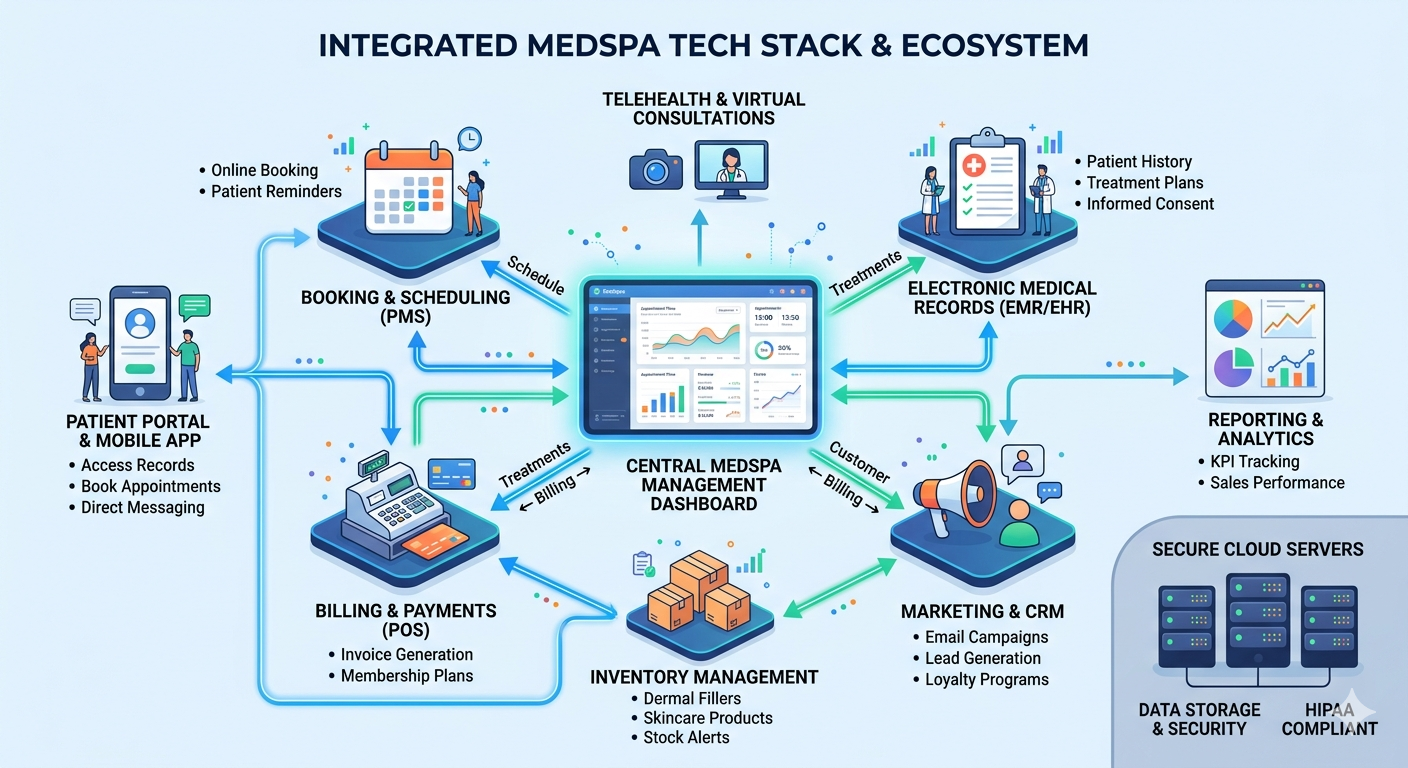
Your medspa tech stack is either your competitive advantage or your biggest operational drag. [Add caption here]
Why Your Medspa Tech Stack Matters More Than You Think
Here’s the uncomfortable truth: your medspa tech stack determines your ranking position, your booking conversion rate, and your profit margin. Yet most practice owners treat technology as a back-office expense, not a business driver.
Therefore, when your systems don’t integrate, you lose visibility in four critical ways: (1) Your booking redirects send patient authority to third-party domains instead of yours, suppressing your SEO; (2) Your EMR and marketing platform can’t share data, making attribution impossible; (3) Your website loads slowly because it’s running legacy code, killing mobile conversions; (4) Your patient data is duplicated across systems, creating compliance risk.
of growing medspas have a fragmented medspa tech stack with zero integration
more ad spend required annually when your medspa tech stack doesn’t support attribution
average booking drop-off rate when medspa tech stack creates checkout friction
of medspa marketing failures trace back to medspa tech stack issues, not content
Additionally, the companies that optimize their medspa tech stack see compounding returns: rankings improve because authority stays on their domain; conversions improve because booking is frictionless; attribution improves because systems communicate; and compliance improves because data is clean and organized.
The 7 Critical Systems in Your Medspa Tech Stack
A complete medspa tech stack includes seven core systems. Although vendors vary, the structure remains constant. Let’s break down each layer.
1. EMR (Electronic Medical Record) System
Your EMR is the single source of truth for patient medical history, treatment records, contraindications, and outcomes. Because your EMR contains sensitive health information, it must be HIPAA-compliant and accessible only to clinical staff. However, because EMR data drives marketing insights, it must also integrate with your CRM for appointment follow-ups and treatment recommendations.
What to look for: HIPAA compliance, provider-specific note templates for medspa treatments, integration with CRM and booking system, mobile access for on-floor providers.
2. Booking/Scheduling System
This is your highest-impact medspa tech stack decision. Because your booking system controls whether patients complete appointments or bounce mid-checkout, it directly impacts revenue. More critically, because booking redirects send SEO authority off your domain, the decision to use external or embedded booking affects your long-term search rankings.
What to look for: On-domain booking (embedded widget, not external redirect), mobile-optimized checkout, integration with EMR, automated confirmation/reminder sequences, ability to block times based on provider availability.
3. CRM (Customer Relationship Management)
Your CRM tracks patient lifecycle: acquisition channel, treatment preferences, lifetime value, rebooking patterns, and communication history. Specifically, your CRM should integrate with your email marketing tool, your booking system, and your analytics platform so you can see which channels drive the highest-value patients.
What to look for: Native email marketing capability or clean API to your email tool, lead scoring, pipeline visibility, integration with booking system, mobile app for staff access.
4. POS (Point of Sale) System
Your POS handles payment processing, retail sales, invoicing, and accounting exports. Importantly, your POS must integrate with your booking system so that cancellations, no-shows, and upsells are recorded in real time.
What to look for: Integration with booking system, real-time syncing with accounting software, support for multiple payment methods, retail inventory tracking, reporting that ties revenue to provider and treatment.
5. Website & Content Platform
Your website is your primary SEO asset and the entry point for 80%+ of patients. Therefore, your website must load fast (under 2.5 seconds on mobile), have embedded on-domain booking, and support structured data for treatment pages.
What to look for: CMS that doesn’t bloat code, mobile-first design, embedded booking capability, blog functionality for content marketing, clean URL structure for multi-location practices.
6. Analytics & Attribution Platform
Without proper analytics, you can’t answer the most critical question: which channels drive the most valuable patients? Your analytics platform must track the full patient journey: channel → website → booking → appointment → treatment → repeat bookings.
What to look for: Ability to tie web sessions to actual appointments, integration with booking system and CRM, UTM parameter tracking, cohort analysis, attribution modeling.
7. Email Marketing & Automation
Consequently, your email platform is where you drive rebooking, upsells, and review requests. Specifically, your email tool must receive data from your CRM (appointment history, treatment preferences) and your booking system (confirmation sequences, reminder campaigns).
What to look for: API integration with CRM and booking system, automation workflows triggered by appointment events, mobile-responsive templates, A/B testing capability, detailed reporting on open/click/conversion rates.
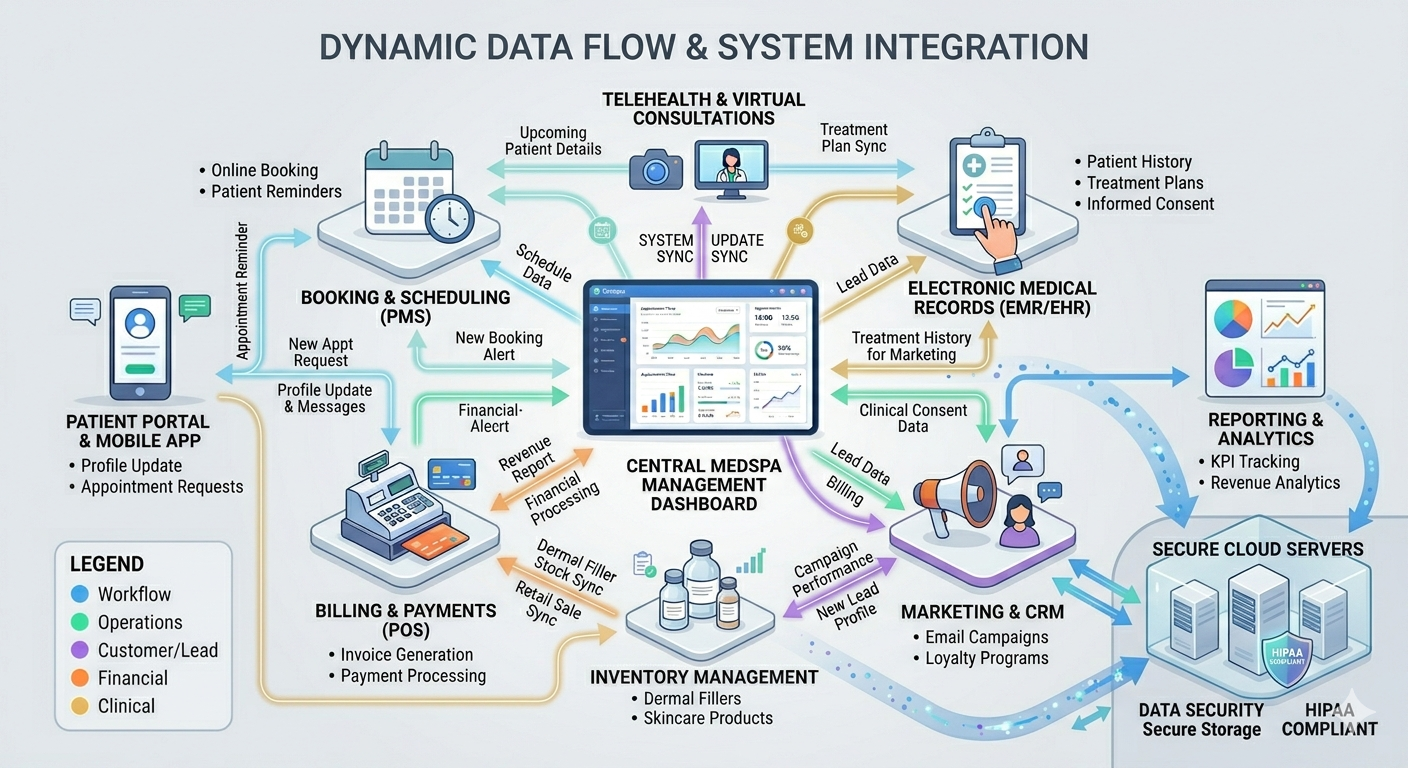
A proper medspa tech stack has data flowing bidirectionally between systems. [Add caption here]
How to Integrate Your Medspa Tech Stack for Maximum Impact
The quality of your medspa tech stack isn’t measured by individual vendors — it’s measured by how they communicate. Because isolated systems lose data, duplicate work, and prevent attribution, integration is non-negotiable.
Integration Layer 1: Booking System ↔ EMR & CRM
When a patient books an appointment, that event must flow into your EMR (so providers see treatment history) and your CRM (so marketing can track appointment completion and outcomes). Furthermore, when a provider documents a treatment in your EMR, that outcome must flow back to your CRM so you can track which treatments drive rebooking.
Integration Layer 2: CRM ↔ Email & Analytics
Your CRM must push patient records to your email platform so that follow-up sequences use real appointment data, not generic templates. Meanwhile, your analytics platform must receive booking data from your CRM so you can trace web sessions back to actual appointments and revenue.
Integration Layer 3: Website ↔ Analytics & Booking
Your website must have clean UTM tracking so analytics can identify which pages drive conversions. Additionally, your booking widget must be embedded on your site (not an external redirect) so that the conversion event stays on your domain for SEO purposes.
Critical insight: Most medspa tech stack failures happen at integration, not at the system level. Two best-in-class tools with zero integration deliver worse results than two mid-tier tools that sync perfectly. Choose integration-first.
Common Integration Methods
API (Application Programming Interface) is the gold standard — it allows real-time, bidirectional data flow. Middleware platforms like Zapier or n8n can connect tools that lack native integration, though they’re slower and less reliable than native APIs. Database integration (shared or synced) works but creates dependencies and compliance risk.
7 Costly Medspa Tech Stack Mistakes (And How to Avoid Them)
Because building a medspa tech stack is complex, mistakes are common. Here are the seven most expensive ones.
Mistake #1: Using External Booking Redirects
When your booking button redirects to an external vendor-hosted page, every click sends SEO authority and conversion signals to that vendor’s domain, not yours. Over time, this compounding authority leak significantly suppresses your rankings. Fix: Move to embedded on-domain booking immediately.
Mistake #2: Choosing Vendors in Isolation
Selecting an EMR without confirming it integrates with your booking system, or a CRM without checking email integration, creates costly downstream gaps. Fix: Map your entire medspa tech stack before purchasing any tool. Verify integration before signing contracts.
Mistake #3: Ignoring Mobile Performance
If your website platform is slow on mobile (over 3 seconds load time), you’re losing 35%+ of bookings before they happen. Fix: Test on real mobile devices. Optimize images. Use a CDN. If your platform is inherently slow, migrate.
Mistake #4: Not Planning for Growth
Your medspa tech stack should support 2–3 new locations without major rebuilds. If you choose location-specific tools, scaling becomes exponentially harder. Fix: Select vendors with multi-location capabilities from the start.
Mistake #5: Letting Vendors Choose Your Integration
Vendors have incentive to keep your data siloed (higher switching costs). Don’t accept “we’ll figure out integration later.” Fix: Require native API integration as a contract term before purchase.
Mistake #6: Poor Data Quality
Duplicate patient records, inconsistent phone number formatting, and mismatched email addresses break integrations and corrupt analytics. Fix: Conduct a data audit before implementing new systems. Establish data governance rules.
Mistake #7: No Migration Plan
Switching from one medspa tech stack to another without a proper plan costs weeks of appointments and data loss. Fix: Plan migrations in phases: data audit → parallel run → staff training → cutover. Budget 4–8 weeks.
Your Medspa Tech Stack Audit Checklist
Use this checklist to evaluate whether your current medspa tech stack is supporting your growth or suppressing it. Check each item that’s true for your practice.
- Your booking system is embedded on your domain (not an external redirect)
- Your EMR integrates with your CRM via native API or middleware
- Your booking system syncs appointment data to your CRM in real time
- Your CRM sends patient data to your email platform for personalized sequences
- Your website tracks conversions with proper UTM parameters and analytics integration
- Your POS syncs revenue data to your analytics platform for attribution
- You have a single patient database with zero duplicate records
- Your website loads in under 2.5 seconds on mobile (test at pagespeed.web.dev)
- Your team can generate a report showing patient value by acquisition channel
- Your medspa tech stack supports multi-location management without major rebuilds
Scoring: 8–10 checks: Your medspa tech stack is healthy and supporting growth. 5–7 checks: You have integration gaps costing you bookings and revenue. Under 5: Your medspa tech stack needs a comprehensive audit and rebuild plan.
We Specialize in Medspa Tech Stack Optimization
While most agencies sell you new software, we diagnose what’s broken in your existing medspa tech stack. Because we understand how EMR, booking, CRM, and analytics integrate, we can rebuild your infrastructure to drive rankings, bookings, and profitability without replacing vendors unnecessarily.

Frequently Asked Questions

The medspa practices scaling fastest aren’t the ones with the best marketing — they’re the ones with the best medspa tech stack. [Add caption here]
Find Out Exactly What’s Wrong With Your Medspa Tech Stack
Our free audit identifies every integration gap, authority leak, and conversion friction point in your medspa tech stack — plus the exact impact each fix will have on your rankings and revenue.